Lightweight
Density is approximately 2.7g/cm³, about one-third of carbon steel at approximately 7.8g/cm³.

An aluminum cover system protecting potable-water, wastewater and industrial water-treatment facilities through corrosion resistance, low weight, tightness and heat reflectivity.

Aluminum provides corrosion resistance through its protective oxide film, excellent formability, low density compared with carbon steel, recyclability and hygienic characteristics. World Bridge applies these properties to roof and cover solutions for water-storage and treatment facilities.
Density is approximately 2.7g/cm³, about one-third of carbon steel at approximately 7.8g/cm³.
The protective oxide film provides strong resistance in sewage, wastewater and industrial wastewater environments.
Low melting point, high recyclability and non-toxic material characteristics support sustainable operation.
Summary of aluminum material properties and key benefits in water-treatment facilities.
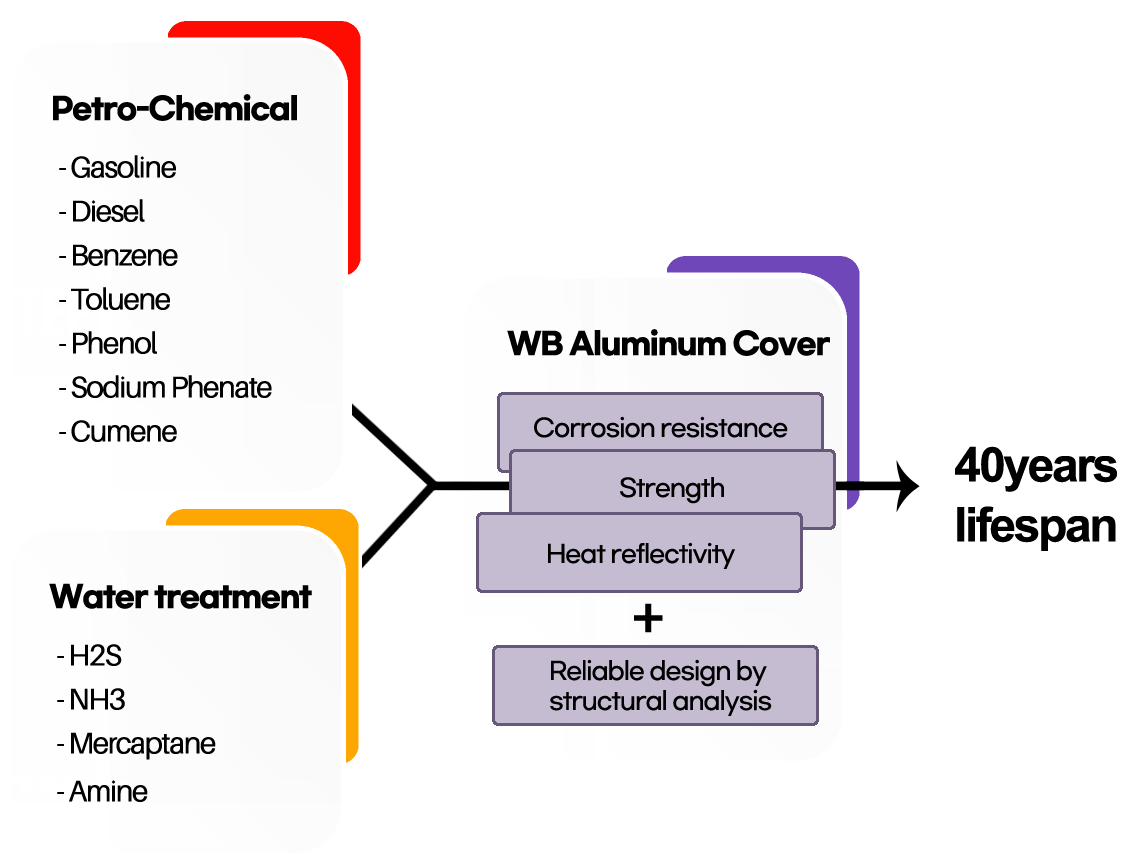
Key design criteria and expected service life for aluminum covers used in water-treatment facilities.
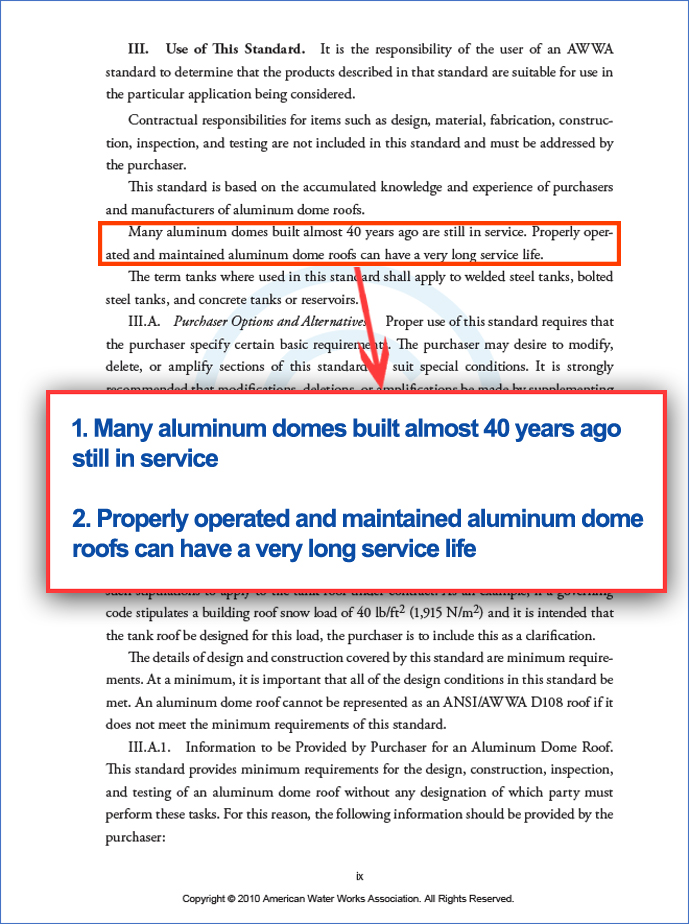
Aluminum Dome Roofs for Water Storage Facilities, First Edition · Page 9 is used as a reference for service-life design.
Long service life and durability help reduce maintenance costs.
Reference service-life comparison: Aluminum 40+ years, SMC 10–15 years, Membrane 8–10 years.
Long-term durability of aluminum covers can be reviewed with the technical data in AWWA D108-10, Aluminum Dome Roofs for Water Storage Facilities (First Edition), Page 9.
With high durability and recyclability, aluminum covers are used as long-term roof solutions for water-storage facilities.

Actual configurations and applications of aluminum covers for water-treatment and water-storage facilities.

Reflects aluminum material properties and the operating conditions required in water-treatment environments.
Comparison of the principal characteristics of Aluminum, SMC and Membrane systems by category.
| Item | Aluminum | SMC | Membrane |
|---|---|---|---|
| Material | Protective oxide film provides strong corrosion resistance to sewage, wastewater and industrial wastewater. Structural design considers dead, snow, live and wind loads with safety factors. | Unsaturated polyester resin + glass fiber, reinforcement and curing agent. SMC panels + aluminum-alloy frame. | Flexible membrane structure with initial tension applied to coated fabric, generally using fluororesin-based materials. |
| Mechanical Strength | Yield strength: panel 145MPa / main frame 245MPa | Yield strength 113MPa | Ultimate strength 40–70MPa |
| Specific Gravity | 2.7 | 1.6~2.0 | 1.0~1.5 |
| Service Life | 40+ years | 10–15 years | 8–10 years |
| Assembly Time | Excellent | Moderate | Moderate |
| Corrosion Resistance | Excellent | Poor | Poor |
| Airtightness | Excellent | Moderate | Moderate |
| Maintenance | Near-permanent service with minimal maintenance cost; low corrosion burden from UV and harmful gases. | Periodic coating required for UV protection; discoloration, deformation and cracking require management. | Shorter service life requires replacement and management of discoloration and deformation. |
| Thermal Performance | High thermal-barrier performance with approximately 5% heat transmittance and 95% reflectance. | Low thermal barrier; sensitive to external temperature changes. | Low thermal barrier; sensitive to external temperature changes. |
| Simplicity | Assembled structure; can be fabricated and installed in various forms including geodesic domes and rectangular covers. | Primarily rectangular type; geodesic dome fabrication is not available and dimensions are constrained. | Processing time is required for seam preparation and high-frequency bonding. |
| Durability | Excellent | Moderate | Poor |
| Environmental Performance | Recyclable at end of life with low disposal cost. | General waste at end of life. | General waste at end of life. |
| Cost | 100 | 80~90 | 60~70 |